


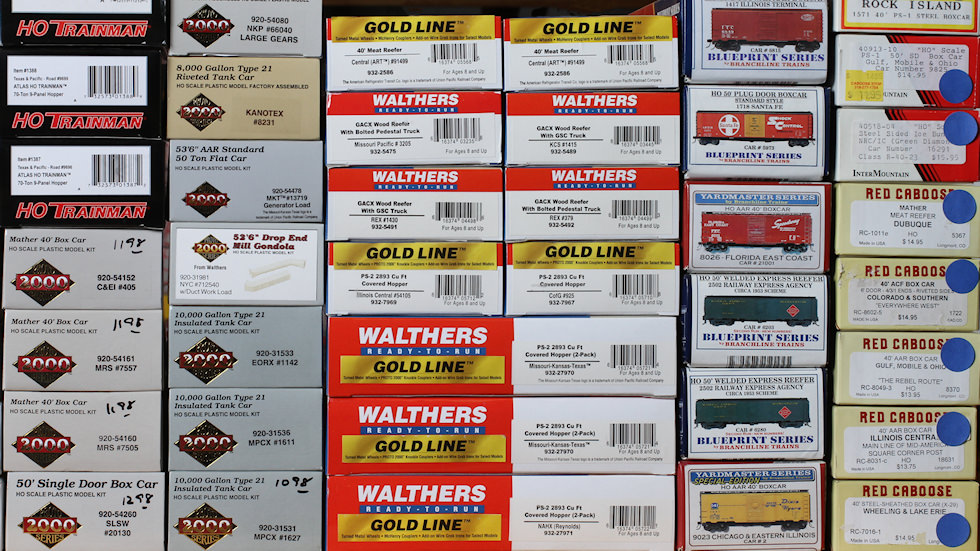
As self-declared Inventory Acquisition Agent for the El Dorado & El Reno Railroad, I have a pretty fair idea of what constitutes the company assets. Part of this knowledge is based on the fact that I am an accomplished shopper. If the NMRA had an Achievement Award for Model Railroad Purchaser, I would have points for spending in excess of $500 on a single item as well as for exceeding the $500 level in a single outing on items costing less than $50 each. Double this skill with two model purchasers for the eL & eL, and the necessity of developing an inventory becomes evident. We needed to know what we had, how many, and quite possibly who is planning to build an item and, in the case of structures, where it’s going to go on the completed layout.
Developing a comprehensive inventory of a model railroad’s stock – cars, engines, structures, details, books, and tools – serves a number of purposes, for the present, for protection, and for your estate.
No one wants to think about what will happen to the layout or those unbuilt kits when they die or how well they are covered in case of fire, flood, or tornado. But they should. I’ve seen men show off a great purchase at a train show and then comment that it will have to be sneaked into the house or that “she” doesn’t need to know how much this goody really cost. Well, if you go first or if you have a fire, you or your heirs will want a list of what is there and what its real value is. With this mind, take a look at what you have. Does it have sentimental value or is it worth real money? Your will does not need to list each item, but you can indicate that items in a separate list should be distributed to designated recipients. Should a particular item go to a grandchild or fellow modeler, a club or to the NMRA or Museum of Transportation? Is it of special value because of its age, limited availability, custom paint or other special details, or other factors?
The value of your purchases may increase or decrease over time. An unbuilt craftsman-level structure kit may increase in value or remain about the same if something newer is a better quality kit. A car may be worth only the value of its trucks and couplers to someone else. When you are able, record the date of purchase and the price you paid. Update fair market value periodically when you can. (Check the current Walther’s catalog for the cost of unbuilt or like-new items.)
Talk with your family or friends about what should be done with your layout when you die. The NMRA offers estate counseling. They do not dispose of items but can provide appraisers who will protect your model estate’s value. This service is offered even to non-NMRA members.
In the event of damage to your layout or equipment, an insurance adjuster will be more likely to give you something closer to replacement value if you have a good inventory. Keep a copy in your safety deposit box, at your office, or if it’s on a computer program, e-mail it to a friend with lots of storage space. The NMRA’s insurance program, promoted in the Bulletin, also protects your assets at comparatively low cost.
What about the more immediate uses of an inventory? The eL & eL inventory goes to train shows. It helps to answer questions like, “Do we already have Stewart’s Rock Island hopper 89065?” or “Did we buy Korber’s 1900-era water tank?” Unfortunately it doesn’t tell us how many water tanks or Rock Island cars we really need to model western Arkansas. We will, however, be using it to assign structures to particular towns on the layout and eventually we will be using the information about cars, their numbers, type, and length to develop operations. (Car type, road and number are needed for car card or switch list operating systems.)
Inventories can be done in a number of ways. You may wish to start with photos or videotape of your layout, or, in our case, of the warehouse of kits on shelves. At least you will have something to show for insurance purposes. Old-fashioned 3×5 cards can contain the same information as the newest version of software, but while they are better than nothing, they do not offer the ease of reshuffling information that a computer database does.
Here is what we have done. Our inventory is currently in Paradox, but may eventually be transferred to Microsoft Access. Most database and spread-sheet programs have the same basic functions and will import information from other programs. Otherwise no one would want to change programs and have to re-enter everything.
Our car list records car type (box, caboose, flat, gondola, etc.), road name, car number, car length, color, wheel sets (included or not), wheel type, build date, special notes such as commemoratives or custom paint or door styles, our purchase cost, and the model’s manufacturer. We also note its status as an unbuilt kit, in service, or in shop because it needs couplers, weights or other attention.
The structures list contains the structure name or description, its manufacturer, primary material such as plastic or wood or plaster, status, cost, construction notes, location notes (rural, town, or large city), builder, skill level, and specific site intended.
The details list records the product, a description, manufacturer, cost, and a code for the kind of detail: building components like windows, building details such as signs or roof details, figures, scenery, track, or vehicles.
Engine records indicate road name, locomotive number, loco type, manufacturer, paint scheme, wheels (for steam), cost, and status. For any of these lists, other categories might be added or left out, depending on the preferences of the user.
The magazine inventory is a spreadsheet listing months across and years down for each magazine for which we might wish to fill in the gaps. It serves as a quick reference for what is immediately available if we locate something in our Data Train program or if odd issues are offered at a train show. We also have a list of many of the train reference books we own.
Obviously, in a computer database, consistency is very important in entering data. If abbreviations are used, they should be standard. For example, in an alphabetized list or report, American Model Builders will be close to AMB, but CRI&P would be greatly separated from Rock Island. Duplicates are harder to spot, and counts would split between the two names.
For the inventory notebook, reports or lists can be printed out several ways for easy reference. The car list may list car type in the first column, followed by road name. A second list might first organize cars by manufacturer and then car type or road name. Of course, if one wished, the list could be reordered by color or length or status. (Unfortunately with over 300 cars, the status of most of ours is “unbuilt.” I’m afraid to run the actual count.)
Our shopping inventory notebook also contains notes on proposed paint colors, a list of the Rock Island freight car roster in July 1952, a Model Railroader chart of plastic HO diesels available, and the occasional product list for mail orders or 1-800-BUY-MORE calls between train shows and hobby shop visits.
An inventory program does not take much time to set up, although entering the data can be tiresome. Eventually when everything is caught up, it becomes easier to enter new items as they are purchased – especially if you get someone else to do it. Consider taking the time to develop an inventory. Someone may thank you some time in the future and, who knows, you may discover things you had forgotten you had.


