


by Dave Roeder, MMR
Early operations
The Webster Groves & Fenton RR was planned from the start as an operations oriented railroad. I wanted lots of switching and as many rail side industries as possible to create traffic. Compromises had to be made. The time period of the 1980’s made some of the switching somewhat fanciful and the train lengths were shorter than prototypical, but operations came first. I started out in 1994 as soon as the track work was down and some scenery was in place.
The first sessions were very informal using hand written switch lists made up on the spot. I would invite a random group of guys over and we would run the switch lists as best we could. These early switch lists were the basis for my emerging operations schedule. I soon realized that the computer was a much more efficient way to keep switch lists. The next step was to get organized and put the trains in some sort of order. Since I was not interested in doing it exactly like the real railroad, it was a simple matter to number the trains I had staged in the main yard and send them out in that order.
It soon became apparent that we had too many through trains, so I started tweaking the schedule to create a total of 12 jobs that could be done in about 3 hours with a crew of 6 or 7 people. I was not able to eliminate all of the through trains on my first pass at a schedule. This was caused by not having enough trackside industries and not having industries that matched the freight we were trying to deliver. You can’t have coal hoppers at a grain elevator or tank cars at a rock quarry. I had way too many flat cars with nice loads and no place to deliver them. I had boxcars with roof walks and gondolas with rivets. This was when I entered into the brutal phase of “thinning the herd.” I had to get rid of any freight cars that did not fit the era or were of no use on the railroad. I gave some away, sold some; and in general just took them off the layout and hid them in boxes. The layout now runs with 220 freight cars. I will not add more, if I get something newer or better, then something else goes. It is a discipline that must be adhered to if I want to run 12 trains as scheduled.
The details of operation
The railroad has a single track main line with a loop for continuous running, but during operating sessions the railroad runs as a point to point layout. I re-set the jobs between each monthly session. The schedule is done in excel spreadsheet with a separate sheet for each train order. A master schedule sheet provides the dispatcher with the overall game plan and each train order has notes describing the details of the switching moves. Sidings are all numbered and turnouts are lettered. The control panels have full details showing numbered sidings as well as lettered turnouts. Manual ground throws are all close to the fascia. I have made 1/4″ diameter metal discs soldered to .031” music wire with the turnout letters on them to assist crews in identifying the various powered turnouts in the switching areas. These can be rotated sideways for photography making them invisible.
Other operational aids include clearly marked names on all major areas of activity, Place names and directional arrows for all destinations mentioned on the train orders. These items are all generated on the computer in an Excel spreadsheet using Microsoft word art and draw. I provide hooks to hold the clipboards with train orders and schematics as well as cup holders for beverages. The most common requests are for more cup holders. The floor is covered with black foam rubber interlocking squares and I have numerous bar stools for seating. I provide various devices for uncoupling cars since everyone seems to prefer a different type. The most recent is a 1/4″ wood dowel sharpened in a pencil sharpener.
#108 The Valley Park Cement Train
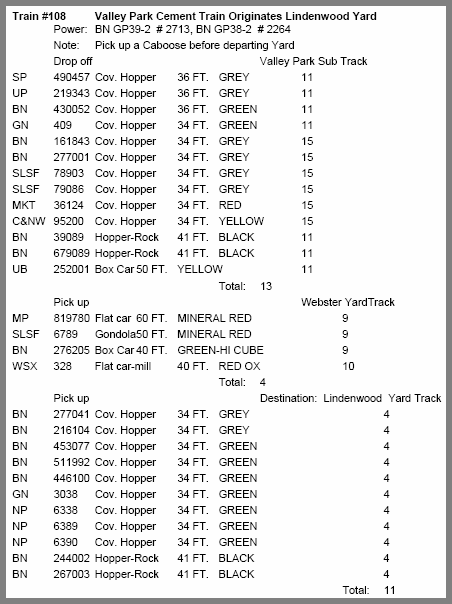
The paperwork for train #108 is typical of the jobs run on the WG&F during one of the monthly sessions. This train is blocked and has the power attached. It sits in Lindenwood yard ready to go lacking only a crew and a caboose. We run cabooses because I like the looks of them on the rear of the freights.
Caboose Tale
The BN had gotten rid of cabooses by the 80’s, but as late as 1993 there were still some holdouts, including one in the Hall Street Yard in north St. Louis. The yard crew used it to eliminate long walks in the cold when blocking cuts of grain cars. The story was that it had been taken off the books but escaped the cutting torch. It was lost to the BN but not to the yard crews who made good use of it.
Getting out on the road
When train #108 is ready to depart, the crew (one person) takes the train order from the dispatcher and checks the consist. (A copy of the train order for #108 is included. This is the paperwork carried by the engineer. Pencils are provided for use in marking off cuts of cars on the train order as they are blocked.) This train has 2 locomotives placed back to back since it has to move West first, then East for two more moves.
The engineer pulls down the yard lead to clear the switch for the caboose track. A reverse move allows him to pick up the next caboose in line. Train #108 is not released until the switching crew (two people) over in Valley Park have blocked the empties and communicated this to the dispatcher. After getting clearance for the move, train #108 pulls out and proceeds directly to Valley Park. Upon arrival, they drop off 13 cars per the orders and then wait until the switching crew puts 15 cars on the rear of what was the front of the train coming in to Valley Park. The caboose is also placed at the opposite end of the train as it came in.
The next move takes the 15 car train out on to the single track main heading East to the Webster Groves Yard. Sometimes traffic on the main will require #108 to hold a siding while some other work is done. If all goes as planned, #108 arrives in Webster Yard where the yardmaster accepts 4 set outs from the front of the train. The remaining 11 cars and caboose then request permission to head East once again returning to Lindenwood Yard. The train enters Lindenwood Yard from the East and pulls into yard lead #4. This ends the job.
Plan it, Build it, Run it
There is no substitute for running trains to gain experience and confirm your general direction as the railroad takes on a more finished look and the operating crew becomes more familiar with your overall operation scenario. Early operation sessions pointed out the need for changes in rolling stock and a switch from 6 axle to 4 axle diesels. These are things I did not see when doing the track plan. A good track plan is a requirement, but you also need to have operation experience to create a smooth running railroad.


