

originally presented as a clinic at the NorthStar 99 NMRA National Convention
INTRODUCTION
Timetable and Train Order Operation is a method of keeping trains from having collisions and, at the same time, move the trains efficiently over the system. There are a number of people involved in this with different duties. In addition, this is paperwork driven and therefore a number of forms are needed. Also, everyone involved in the system must know the rules. The last item is of paramount importance. If even one person does not know the rules or makes a mistake in interpreting the rules, people could die. However, the vast majority of trains moved under timetable and train orders during the steam era with few accidents considering the actual volume. Emulating this system can be both fun and entertaining. We as modelers do not need to worry about the drastic consequences faced by railroads under this system. Instead we can good-naturedly rib the person who makes a mistake.
There are two different kinds of dispatching methods. The first attempts to separate the trains by time and the other by distance. Timetable and Train Order is within the former category. While this system can be overlaid with automatic block signaling (ABS), this is primarily a system of separating trains by time.
This material is intended as a beginning point only. A number of items are not discussed such as the “X” response (Rule 212). For a better understanding I would strongly encourage you to seek information from period sources, friends, and the Operations Special Interest Group (OpSIG).
Please note that throughout this work, the Missouri Pacific Lines’ Operating Rules effective November 1, 1940, are used. In addition, Missouri Pacific Lines’ timetables are used to modify the Operating Rules and serve as examples. As always, these may not be correct for any other railroad and an accurate portrayal of any other railroad requires the appropriate research into the railroads operating books, timetables, and other data. (For instance, these rules are not correct for the B&O railroad which used a variant of these rules.) Moreover, this is subject to correction and the most up-to-date version can be found at www.gatewaynmra.org on the pages for clinic materials.
INITIAL CONSIDERATIONS
I. Prototype
I would suggest looking to your prototype to determine what method of train dispatching you would like to use. Timetable and train order has variations based on the prototype and in order to be accurate obtain a rulebook from the era that you model. If you are not modeling a prototype, use a railroad you use as a reference to determine your other prototype practices. In this way you may borrow the information and use the book to make your operating sessions more authentic.
II. Era
Timetable and train order operations are also somewhat era specific. Not too many railroads use timetable and train order operation anymore. However, this type of operation was still used until at least the 1970s. It would be somewhat incongruous to model that type of operation with SD90MACs.
III. Traffic Patterns
Timetable and train order operation was not employed on heavily used mainlines after the invention of centralized traffic control (CTC). Lines that receive heavy traffic were quickly converted to CTC because this allowed a single track to carry 70% of the traffic of a double track main line. In addition, on single track it greatly decreased the time a train waited at a siding for another train to appear. The dispatcher just gave orders for the other train to move to a new location for a meet. It is difficult if not impossible to change the location of a meet in T&TO operation if one of the trains passed the last operator prior to the meet location.
Positions Involved
Dispatcher-The most important position involved in this intricate process is that of the dispatcher. This person is responsible for making sure
that all trains are on schedule and then to send out train orders to adjust the published schedule so that the trains move across his territory as efficiently as possible.
Operator-The operator is the next position. The operator is responsible for receiving orders from the dispatcher, making sure the approach signal is correctly set, and then the operator must transfer the orders to the conductor and engineer.
Conductor and Engineer-The conductor and engineer are the third set of persons who are involved in this process. The conductor and engineer both receive a copy of the orders from the operator, make sure that they understand the orders, and then operate the train accordingly.
Tools of the Trade
Timetable-This device was essential. All employees were required to have a timetable with them. The timetable contained numerous types of important information of immense value to the employee. There were keys to all the different abbreviations and symbols. This allowed the railroader to quickly determine any abbreviations or symbols he forgot. The timetable would list the different stations, the milepost of the station, the station number, and a list of scheduled trains. Usually all first class, second class and third class regularly scheduled trains were listed. In addition, Missouri Pacific Timetables indicated which stations were places where crews could receive orders by various abbreviations. D (for day) were one trick stations; N (for night) were two trick stations; and, CS (for continuous service) were open 24 hours a day. Bold typeface denoted register stations. Operating employees always carried this with them.
Operating Rulebook-This book was a hardbound book that contained the general operating rules that governed all operations on the railroad. If it was not in this book, it could not be done. Violation of any rule caught by a superior could earn the employee some sort of punishment from a dressing down to suspension without pay to termination of employment. This was the bible of the railroad employee and was memorized for the most part. The book was not always with the employee but he was charged with knowing everything in it.
Train Register-This is a book maintained at designated stations where a crew can look to determine what trains have passed. This book will have the signals displayed, the time of arrival and departure of trains and other necessary information. This information may include the date and train number. Every railroad is different and its books will give you the answer.
Clearance Card-This is a document that indicated that the train crew had authority to operate. Every train had to have this to operate. The initial form would be authorized by the dispatcher, bear his initials, and be countersigned by the operator.
Orders-These are instructions from the dispatcher, delivered through the operator, to the engineer and conductor of a train which either gives them the authority to operate, as in the case of an extra, or modifies the schedule which exists in the timetable. There are two different kinds of orders. Form 19 orders are hooped up to the engineer and conductor by the operator once the train is underway. Form 31 orders require the train to stop and the engineer and conductor must each sign for the order. Either set can be delivered at the start of the run but the engineer and conductor must still sign for the Form 31s. These orders can be picked up at any station where a train stops or passes so long as an operator is present.
Train Order Book-This is a book owned by the railroad and similar to a hardbound journal type of book. In this book the dispatcher would write each of his orders. He would write the order as he informed the operators of his orders. As they repeated the order he would underline the words and initial the order. The dispatcher would write the order number to the left, the numbers of the trains the order concerned, and the operators who received it. After the operators the dispatcher would note the time the order was completed. Under this the order was written. The dispatcher’s initials were under the order. When the order was no longer valid, the dispatcher would indicate the order was not valid by making some mark. This was standardized by railroad.
Train Sheet-This is a large piece of paper that the dispatcher uses to maintain his knowledge of where every train is on his railroad. Not all sheets were alike and there were differences. However, some generalizations can be made so that a reasonable sheet can be generated for model usage. First, all of the stations shown on the timetable were listed down the center. Mileage was also shown just like on the timetable. The train sheet also listed the capacity of the sidings and the call letters for the individual stations. The left side of the sheet would be for one direction and the right for the other. Along the top were spaces to write in the train number. Under the spaces there was room to write down relevant information about the train such as the engine number or engine numbers, the tonnage, conductor and enginemen, and the time on and off duty. At the bottom time on or off duty would again be provided. On each line the dispatcher would mark the time the train was “OSed” by the operator and a smaller box was provided for the number of loads and empties. This sheet provides a detailed look at a railroad for a given day. By looking at the sheet a person can learn what trains were moving across the railroad, the number of load and empties, and where the trains performed switching. In addition, the names of train crews were listed along with the engine numbers.
The Clock-This is the standard clock by which all railroad men set their clock. Everyday the railroad would send a signal at a specific time so that all dispatchers would set the clock to the appropriate time. In this way all clocks on the railroad had the same time. Each railroad man would then set his pocket watch by this clock and then all persons would have the correct time.
Turnover Sheet-This is a sheet provided to the next trick dispatcher which lists all active orders, the locations of all trains (north and south) and the location of all helpers.
GENERAL RULES
There are three general rules that govern all trains and are the foundation of railroad operation. From these three rules all other rules follow and they must be known by all involved as well as they know their own names. These rules are different based on single or double track. (I have used the Missouri Pacific Operating Rule Book numbers following the organizational format. S-single and D-double)
Superiority of Trains
1. S-71 A train is superior to another train by right, class, or direction.
- Right is conferred by train order; class and direction by time-table.
- Right is superior to class or direction.
- Direction is superior as between trains of the same class
D-71 A train is superior to another train by right or class.
- Right is conferred by train order; class by time-table
- Right is superior to class.
2. S-72 Trains of the first class are superior to those of the second; trains of the second class are superior to those of the third; and so on.
- Trains in the direction specified by the time-table are superior to trains of the same class in the opposite direction.
D-72 Trains of the first class are superior to those of the second; trains of the second class are superior to those of the third; and so on.
3. 73 Extra trains are inferior to regular trains.
These rules contemplate that trains running in double track territory are using directional running. All westbound trains will use one track and eastbound trains will use the other. Therefore, no westbound train needs to get out of the way of an eastbound train because the westbound train is inferior. The train only need worry about trains in front of it moving slower than it and trains behind it overtaking it.
By reviewing the rules class and direction are conferred by the timetable. First class trains are superior to all other trains, second class trains are superior to all third class trains and extras. On the Missouri Pacific Lines eastbound and northbound trains are superior to trains of the same class in the opposite direction. (The timetable listed stations in the direction they occurred unequivocally establishing direction by the order of the stations in the timetable.) Therefore a second class eastbound train is superior to a second class westbound train.
This system worked well for all scheduled trains. When extra trains are added, they had rules to follow in order to stay out of the way of regular trains. However, this could be very inconvenient for the railroad. Therefore, orders would confer right on a train making it superior to another train to which it was inferior.
This is were the terminology arises with the word “right.” Extra trains are given “right” over first class trains by the dispatcher to enable the extra to operate when the normal rules would prevent it. Therefore, an order would issue giving the extra 1712 right over train 3. Train 3 is a passenger train and an extra would have no ability to interfere under the normal TT&TO rules. However, the Dispatcher has accorded right on the extra making it superior to the first class passenger train.
Reading the rules another way, trains given right are superior to all trains in accord with the train order issued by the dispatcher. Trains of the first class are superior to second and third class trains. Second is likewise superior to third class trains. Between trains of the same class, those headed north or east are superior to those headed south or west. Extras fit in wherever they could when they operated without orders.
One final note of general application, on the Missouri Pacific Lines there were three kinds of extras: 1.) extras (all other extras not in the second or third group); 2.) passenger extras (these carried passengers and were not regular trains); and, 3.) Work extras (these were work trains.) Extras always displayed white signals.
Movement of Trains
82 Time-table schedule, unless fulfilled, are in effect for twelve hours after their time at each station.
Regular trains more than twelve hours behind either their schedule arriving or leaving time at any station lose both right and schedule, and can thereafter proceed only as authorized by train order.
S-83 A train must not leave its initial station on any subdivision, or a junction, or pass from on of two or more tracks to single track, until it has been ascertained whether all trains due, which are superior, have arrived or left.
S-83 (a) When a train is restricted for an opposing extra train, at a register station, the restricted train must not leave unless the extra train can be seen or a train order is received superseding or annulling the restriction, or stating that the extra train has arrived.
D-83 A train must not leave its initial station on any subdivision, or a junction, until it has been ascertained whether all superior trains due have left.
Rule 83 provided for many different situations not normally found on model railroads. However, some should be known. First, Form V must be used whenever the Conductor & Engineer (C&E) do not check the register. This is normal when the crew violates the hours of service law and they are not at a train register station. Other important parts required the conductors only to register and check the register at all register stops unless relieved of this by special order. Engineers only had to check the register at the initial stations unless they received a Form V. They could check at intermediate stations when practicable; if not, they must require from the conductor a register check, showing the numbers of all superior trains and the time of those which have arrived or left.
86 In automatic block signal territory, unless otherwise provided, an inferior train must clear a first class train or train of superior right in the same direction so as to avoid giving a restrictive indication to the following train.
Outside of automatic block signal territory, unless otherwise provided, an inferior train must be in the clear at the time a first class train or train of superior right in the same direction is due to leave the next station in the rear where time is shown; except that if the time between stations is less than five minutes, or the distance between stations is less than three miles, the inferior train must be in the clear at least five minutes in advance of time shown for superior train at the next station in the rear.
This rule makes sure that a superior train following an inferior train is not held up unnecessarily. Therefore in ABS territory, the train must be so far in advance to avoid a restrictive signal to the superior train following. Outside of ABS territory, the inferior train must be in the clear at the time the superior train in the same direction is due to leave the station immediately behind according to the timetable or train order. If there is less than five minutes or three miles between these stations, then the inferior train must be in the clear five minutes before the train is at the station immediately behind.
But what about trains coming toward you?
S-87 An inferior train must keep out of the way of opposing superior trains and failing to clear the main track by the time required must by protected as prescribed by Rule 99.
Extra trains must clear the time of opposing regular trains not less than five minutes, unless otherwise provided, and will be governed by train orders with respect to opposing extra trains.
Rule 99 requires the rear brakeman and head end brakeman to proceed from the train and carry lighted fusees at night, flags by day, and two torpedoes for placement on the track. This protects the train for other trains in either direction. Also, if another train can overtake the train, lighted fusees must be dropped off of the rear of the train at appropriate intervals to protect the rear of the train from collision.
S-88 At meeting points between extra trains, the train in the inferior time-table direction must take the siding, unless otherwise provided.
Trains must pull into the siding when practicable; if necessary to back in, the train must first be protected as prescribed by Rule 99.
S-89 At meeting points, the inferior train must take the siding and clear the time of the superior train not less than five minutes, except at scheduled meeting points between trains of the same class where the inferior train must clear the main track before leaving time of the superior train.
The inferior train must pull into the siding when practicable. If necessary to back in, it must be protected as prescribed by Rule 99.
S-89 (a) At schedule meeting points between trains of the same class, the superior train must stop clear of the switch used by the train to be met in going on siding, unless switch is properly lined and track clear.
At train order meeting points, the train holding the main track must stop clear of the switch used by the train to be met in going on siding, unless the train to be met is clear of the main track and switch in properly lined.
At meeting and passing points, a train awaiting the arrival of another train must, if practicable, stop at least three hundred feet from clearance of the facing point switch over which expected train will pass.
S-90 (a) At meeting points, the inferior train will use the siding of assigned direction, unless otherwise provided.
Rule 94 provides that if one train overtakes another that is disabled, the second train can assume the identity and schedule of the first and proceed to the next point of communication and report this to the Dispatcher.
Rule 95 provides that multiple sections of a train can be run (such as 21-1 and 21-2) and the sections must display the appropriate signals (green for the first and following sections except the last which has no signals displayed). The sections are run on the same schedule and each has equal timetable authority.
Rules for Movement by Train Order
201 For movements not provided for by the time-table, train orders will be issued by authority and over the signature of the train dispatcher and only contain information or instructions essential to such movements.
They must be brief and clear; in the prescribed forms when applicable; and without erasure, alteration, or interlineation.
Figures in train orders must not be surrounded by brackets, circles or other characters.
202 Each train order must be given in the same words to all employees or trains addressed.
203 Train orders, except restricted speed orders, must be numbered consecutively each day, beginning at midnight. (See Restricted Speed Order, Form X)
204 Train orders must be addressed to those who are to execute them, naming the place at which each is to receive his copy. Those for a train must be addressed to the conductor and engineman, and also to any one who acts as its pilot. A copy for each employee addressed must be supplied by the operator.
Orders addressed to operators restricting the movement of trains must be respected by conductors and enginemen the same as if addressed to them.
Enginemen and firemen and, when practicable, forward trainman must read train orders, check with each other and have a definite and proper understanding of their requirements. Conductors and, when practicable, trainmen, must read train orders, check with each other and have a definite and proper understanding of their requirements.
204 (a) In addition to copies of all train orders and clearances delivered to each employee addressed, an extra copy will be furnished the engineman, and a copy to the rear trainman. When a train has more than one engine in service, two copies will be furnished engineman on each engine.
Other rules provide that the train orders must be written in the Train Order Book. The book will also list the names of all who have signed for the order, the time the order was repeated and the responses transmitted, with the dispatcher’s initials. Sections are designated as “Second 21” not 21-2 when transmitting the order. When transmitting orders by telegraph, time may be stated in figures or duplicated in words. When transmitting by telephone, the numbers of trains and engines in the address may be pronounced and then spelled letter by letter. All stations and numerals in the body of an order must first be plainly pronounced and then spelled, letter by letter. “Naught” was used for zero.
When the train orders are transmitted, the dispatcher must write the order and underscore it when it is repeated back to him.
When two or more engines are coupled, the number of each engine will be used in train orders. When more than one engine is used on an extra train, the word “coupled” must be added. (E.g. Extra 1721 and 1725 coupled south)
In order to transmit an order the dispatcher must first inform the operators which form to use followed by direction and then the number of copies. These train orders must then be transmitted to as many operators as possible simultaneously. When not sent simultaneously, the order must first be sent to the superior train. The several addresses must be in the order of the superiority of the trains. The operators must then write the number of copies requested using carbon paper at the time the order is issued. The operator will write the order and then repeat it while underlining the words as he says them. When more than one operator is involved, the operators must repeat it in the manner they were addressed, that is the superiority of the trains involved.
A form 31 order requires the signature of the engineman and the conductor (and any others addressed). The engineman and conductor must each read the order to the operator. The operator will then inform the dispatcher of their signatures and the dispatcher will then respond “complete,” and give the time and his initials. Each operator will then write “Com” for complete, the time, his last name, and deliver the copies to the engineman and conductor. Form 31 orders are delivered when restricting a train where the office is closed or where no office exists by another railroad employee; when giving the train passed the station or office; when restricting a work extra or annulling an order authorizing a work extra; and, when temporarily discontinuing Automatic Block System.
A form 19 order is written by the operator and then repeated. The dispatcher then says “Complete” and the dispatcher notes the time and gives his initials. The operator then notes “Com,” the time, the operator’s last name in full, and personally deliver a copy to all addressed.
A clearance card is issued to every train. The operator will complete the card with the proper address of the train and the numbers of all train orders addressed to the train, if any. The operator will then transmit the clearance to the dispatcher who will respond “OK” and give his time and initials. The operator will then mark the time and initials on the clearance card and deliver the card to the crew with any orders. The dispatcher must write down the number of the orders given to the train and the time of the “OK.”
Naming a train by its schedule number includes all sections of that train in the order. To name a specific section of the train, the order must address that section.
Train orders in effect continue until fulfilled, superceded or annulled.
Finally, a train must not pass the train order signal set to stop except to take fuel, water, or to perform station work within station limits and then must protect itself as set forth in Rule 99. Operators at a station must also notify the dispatcher of the passing of all trains.
Forms of Train Orders
There are over twenty-two pages of train orders in my Operating Rule Book. I cannot provide them all hear. However, I will write the orders in the examples below and you can learn the major ones from these examples. I would again strongly encourage you to obtain a copy of this book and use it for modeling purposes. However, I will state that on the Missouri Pacific, train orders were issued to the train citing the train number and then the engine number.
EXAMPLES
For purposes of the examples set forth below, I have taken the scheduled trains from Time Table 44 of the Eastern Division of the Missouri Pacific Lines and I am combining them with the rules set forth above. I have modified the Division however for the purposes of the examples to a single track main and I have eliminated a number of the scheduled trains and quite a few stations. The actual Division was quadruple tracked in areas during the World War II era with a turntable and engine servicing facilities for turning the helper engines that assisted trains up Kirkwood Hill. A heavy amount of traffic crossed this division and would be too complex for demonstrative purposes.
Over the last year Allied troops have landed on the beaches of Normandy and are headed toward Berlin. At the same time U.S. troops and the U.S. Navy are swiftly closing on Tokyo from two directions: Australia and the Middle Pacific. You, as an engineer on the Missouri Pacific have been pulling long hours over these past few years moving freight for the war effort and pulling main trains loaded with GIs headed for the war. You have put in long hours running trains over the Eastern Division, doing your part to end the war. The Missouri Pacific, like many other railroads, has handled more traffic than ever and had to rebuild and salvage what it could just to move the freight. The load has been hard. But you have done it all under TT&TO operation.
Imagine you are sound asleep on a cold December 1944 night in St. Louis, Missouri. You are awakened by a telephone call. You hear the crew caller announce that you are called for a 6:00 a.m. train. You sleepily acknowledge the call and begin to gather your grip and make a lunch. You are off to work again.
When you arrive at the crew area in St. Louis you meet your fireman, conductor, head end brakeman and rear end brakeman. At this time you discuss the news and other items. You have some time to kill before you actually need to report. Before the conductor goes to get the orders you decide to look at the timetable to see what is running.
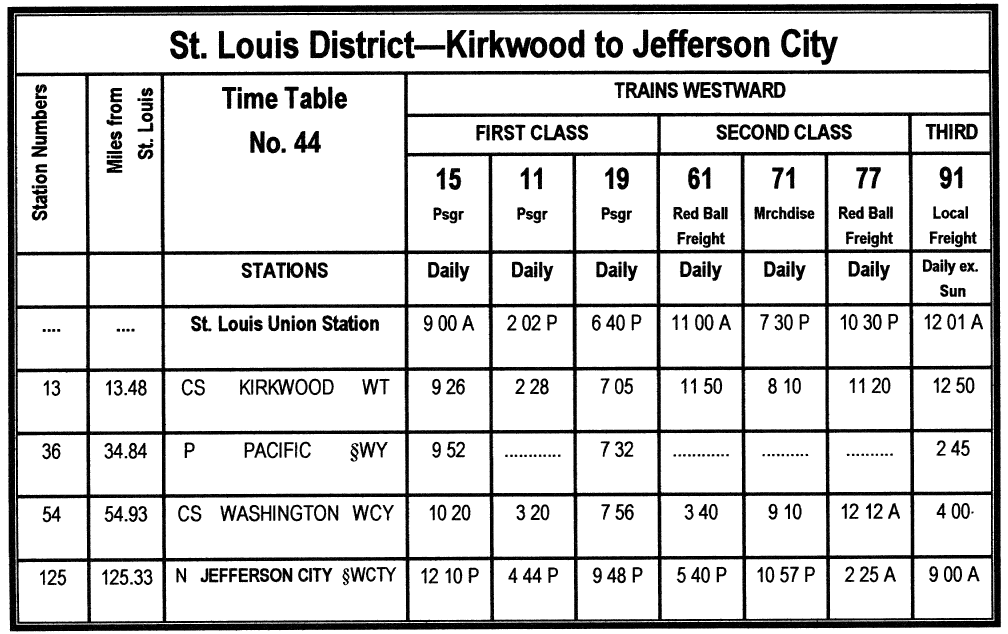
Timetable, Westbound
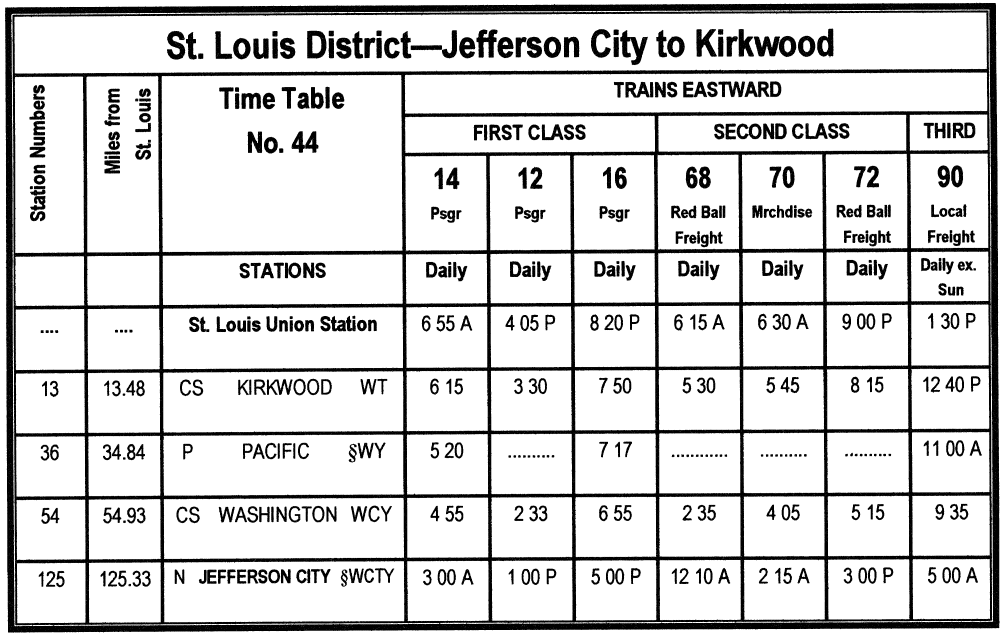
Timetable, Eastbound
Then, after comparing pocket watches, the conductor goes to the operator to obtain the necessary clearance card and any orders. The clearance card would look like this:
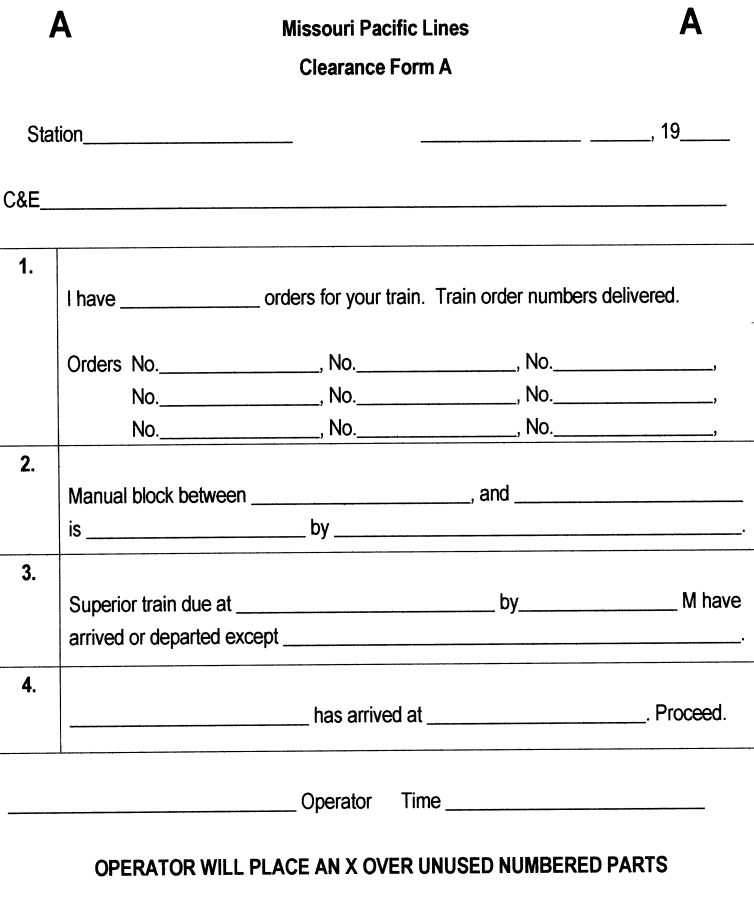
Clearance Form A
This clearance card must be obtained prior to at the beginning of a run and prior to passing any “stop” train order signal.
The orders would look like this (with the appropriate form number on the form (19 or 31):
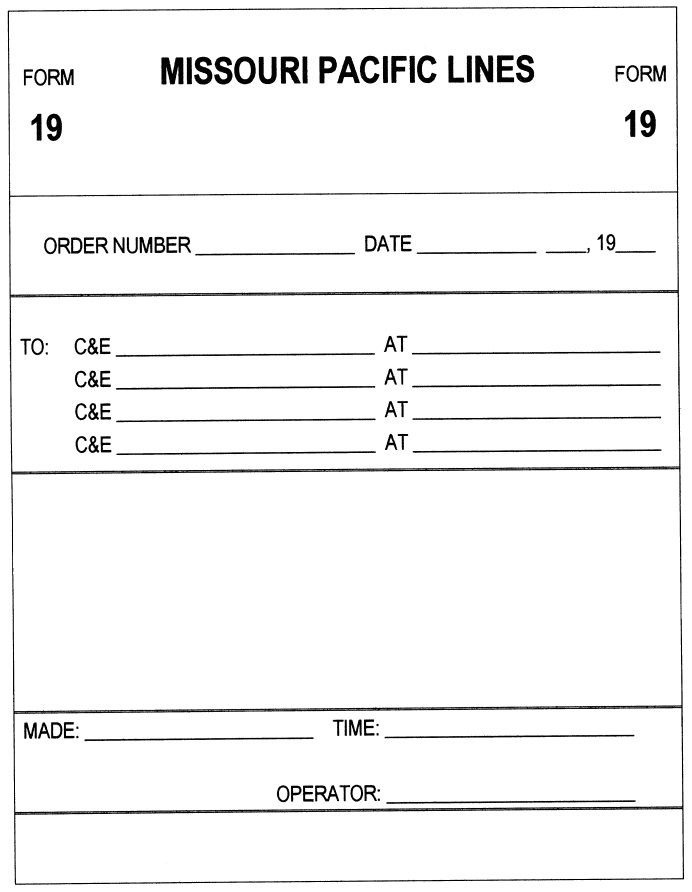
Example Form 19
Inside the block that is empty below the address to the C&E, the operator would write in the order. In addition, there are at least three copies of the order issued. Two are for the C&E and the third is for the operator. If the train is double headed, the second engine would also get a copy. Remember that each engineer must have a copy. The operator would need to give three copies to the passenger train. The operator must give one order to the conductor, engineer, and flagman. Of course the operator will retain his own copy.
Lets look at some of the possibilities we might have.
EXAMPLE ONE
First if the dispatcher did not issue any orders other than the one creating our extra we would receive the following order. The first part would be addressed to the C&E of the engine. The number of the engine designates the number of the extra.
C&E Eng 2203 at St Louis
Eng 2203 run extra St Louis to Jefferson City
(Please remember how this would fit in the form above.)
This is for a train running between St. Louis and Jefferson City such as a military train running between St. Louis and Los Angeles with a load of jeeps for the Pacific Theater. This order creates the train. Without this order, the train would not exist.
But what if the train is a local train picking up finished products from a number of industries between St. Louis and Jefferson City. Then the order might read:
C&E Engine 1708 at St Louis
Eng 1708 run extra St Louis to Jefferson City and return to St Louis
This order allows the train to leave St. Louis, perform its switching between St. Louis and Jefferson City and to return. If the order named any other station the extra would only have authority to operate to that station.
Assuming that we received only the first order we would next have to look at the register. According to the Missouri Pacific Rulebook, the register contains information on the number of the train, its arrival and departure, and other relevant information. These varied by railroad but might also show the date of arrival and signals. Remember a train displaying green signals was the first section and an additional section would be following and entitled to the same superiority as the first. It would not be appropriate to leave a station if the second or third section of the train was not at that station yet.
I always find it easier to look for trains from the same direction first and from the opposite direction next. Therefore, in this example we will look eastbound and then westbound at the register and our timetable.
It is now about 6:15 a.m. Looking at the register we see that only train 71 and local 91 have left and no trains have arrived from the east in the last twelve hours. Neither train 71 nor local 91 were displaying markers. We do not need to worry about any extras because if a conflict existed with our schedule, the dispatcher would issue an order for a meet or allow us to overtake the extra. Returning to the timetable we see that train 77 and train 91 are the only trains which should have left from St. Louis. All appropriate westbound trains are accounted for after our review. But what about eastbound trains? Well it is 6:15 a.m. and train 68 has not arrived. It is superior because it is a second class train. Therefore we must wait for its arrival. How long must a train wait? A train must wait twelve hours for the schedule to expire and the train to lose its superiority. This morning it arrives five minutes late at 6:20 a.m. It displays green flags. Can we go? NO! The green flags indicate a second section if following (and maybe more depending on the flags on each following section.) We must wait. The second section arrives at 6:40 a.m. Can we go? NO! Train 70, another second class train has not arrived. We need to wait for it. It arrives at 6:50 a.m. displaying no signals and we review the timetable and see that train 14 is due at 6:55 a.m. This train arrives at 7:00 a.m. and it also is not displaying any signals. Can we go? Yes. The next westbound train is set to leave at 9:00 a.m. and no other eastbound train is due until 1:30 p.m.
For purposes of these examples, assume it takes our extra the same time to cross the sub-division as it does for train 71 between stations.
EXAMPLE TWO
Now that we know all opposing trains have arrived and no westbound trains are due to leave, we can proceed, but how far? According to the rules, we must clear trains in the same direction either at the time it is due to leave the station behind or, if less than tree miles between stations or five minutes, we must be in the clear five minutes before the time shown on the timetable for the superior train at the station behind us. What about eastbound trains? We must clear eastbound trains by five minutes. It is now 7:10 a.m. and we can get to Kirkwood by 7:50 a.m. No train is due to leave St. Louis until 9:00 a.m. and no eastbound train is due at Kirkwood until 12:40 p.m. We can leave and get to Kirkwood in time.
EXAMPLE THREE
Assuming that the train is a train loaded with new Sherman tanks and headed straight to California, we need to proceed as quickly as possible to Jefferson City where we can turn the train over to a crew. Where is the next station stop? When will we arrive in Jefferson City? Assume it will take 35 minutes to make it to Pacific.
The Answer: We can make it to Pacific by 8:25 a.m. Train 15 is following on our heels but is still not due to be at the last station until 9:26 a.m. The first opposing train is 90 and it will reach Pacific at 11:00 a.m. Therefore we can make it to Pacific by 8:25 a.m. without any problems.
We can make it to Washington by 8:50 a.m. This is over one hour before train 15 is due at the station behind us and forty-five minutes before train 90 is due at Washington.
We can make it to Jefferson City by 10:37 a.m. This is seventeen minutes before train 15 is due at Washington. No problem with that train. However, train 90 will be somewhere between Jefferson City and Washington. Therefore, we cannot proceed past Washington.
We wait at Washington for train 90. Train 90 arrives right on schedule at 9:35 a.m. Can we leave? Train 90 was showing no signals. The train following, 15, will arrive at Washington at 10:20 a.m. That is less than an hour from now. This train cannot make it to Jefferson City and get in the clear by 10:20 a.m. It will take one hour and forty-seven minutes to make it Jefferson City. Therefore we need to sit in the hole at Washington until Train 15 passes us.
EXAMPLE FOUR
Where do we stay? The rules provide that the inferior train must take the siding. We must then run to Washington and drop the head end brakeman to throw the turnout and proceed into the siding and allow both trains 90 and 15 pass.
EXAMPLE FIVE
When can we proceed? Assuming all trains are running on schedule, train 90 will pass at 9:35 a.m. and train 15 will pass at 10:20 a.m. It is now 10:20 a.m. and it will take us one hour and forty-seven minutes to get to Jefferson City. What is the next train behind us? Train 61 is the next train following. It would make it to Washington by 3:40 p.m. We would reach Jefferson City by 12:07 p.m. Therefore we would be in the clear before long before it reached Washington. What about opposing trains? The next opposing train is due at Jefferson City at 1:00 p.m. We would clear that train by fifty-three minutes. Therefore we can now run all the way to Jefferson City, give the engine to the hostler and go to beans. In addition, after eight hours, we can take another run back to St. Louis, provided we are called.
EXAMPLE SIX
Assume we are back at St. Louis. This time we are issued more than one order. We receive the original order:
C&E Engine 2203 at St Louis
Engine 2203 West run extra St Louis to Jefferson City.
We also receive a second order:
Extra 2203 West meet No 90 Eng 124 at Kirkwood Extra 2203 West hold main track at Kirkwood.
How would this have worked? First, the dispatcher would call the operator in Jefferson City and then the operator in St. Louis. Once both are on the telephone, the dispatcher would issue the order. The second order would be given first. Why? Because we must arrange the protection first. Then the order to run engine 2203 as an extra would exist.
Suppose train 90 was late leaving Jefferson City and the tanks were on a time shipment to meet a transport for an invasion. Then the dispatcher might change the superiority of the trains. In that case he would issue an order to two operators at the same time and issue the order restricting the superior train first. The superior train must be restricted first because the inferior train needs protection from the superior train more than it needs authority to proceed. After all, the restriction on the superior train avoids an accident and authority to proceed sets the accident in motion if the restriction has not issued. This problem assumes that train 90 still has not left Jefferson City and that Extra 2203 West is between Kirkwood and Pacific.
In this case the dispatcher might issue orders as follows:
The dispatcher will ring up the operator at Pacific and Jefferson City at the same time.
DS: DS to Jefferson City, 19 West Copy three
Operator at Jefferson City: SD West at Jefferson City
DS: DS to Pacific, 19 East Copy three
Operator at Pacific: SD East at Pacific
DS: Order No 1 Dec 14 1944
At Jefferson City to C&E No 90 Eng 124 at Pacific to C&E Extra 2203 West
Extra 2203 West has right over No 90 Eng 124 Pacific to Jefferson City RJA
Each operator, in the order addressed, will now read back the order. Each time the operator says a word both the operator and dispatcher will underline the word. The operator not addressed will listen for any mistakes. Therefore, the dispatcher should have two underline marks under each word for the two times the order was read back to him, once by each of the operators.
DS: Order No 1 Made complete at 8 10 am
Another item to note, on the Missouri Pacific, time was not allowed in stating a time in a train order. Rule 206.
Now the order is complete and the operators will go and hoop the orders to the crews. One to each engine, one to each conductor, and one copy for each operator. There is also a copy in the order book maintained by the dispatcher.
In this scenario, Extra 2203 West now has right over No. 90. No. 90 is still at Jefferson City and knows it cannot depart because Extra 2203 West has not signed the register. Moreover, the order is effective until it is annulled, superseded or fulfilled. There is no expiration at the end of twelve hours as there is for a scheduled train. Now both trains know of the other and No. 90 will wait until the extra appears.
EXAMPLE SEVEN
What if train 14 was just a little late. If train 14 was running just late enough for our train to get out of St. Louis and safely to Kirkwood or Pacific, then the dispatcher could issue a wait order requiring us to wait a given time at each destination for No. 14 and then proceed if it did not arrive. Train 14 would also receive the order and be aware that it needed to make a specific station by a specific time or clear the rail for our extra.
This is how the order would read.
Extra 2203 West has right over No 14 Eng 6612 St Louis to Washington and wait at Kirkwood until 7 01 am and Pacific until 8 01 am
Under this scenario the extra could leave St. Louis before No. 14 reached St. Louis and could run to Kirkwood. At Kirkwood, the train would wait until 7:01 a.m. for No. 14 to arrive, and if it did not he could then run to the next station and wait until 8:01 a.m. If No.14 did not arrive, the extra could proceed to Washington. No. 14 would receive a copy of the order and this assumes the train is between Jefferson City and Washington and approaching Washington. Note that at Washington Extra 2203 would lose its superiority and would have to wait for No. 14 no matter how long it took to get to Washington.
Also this order deprives Extra 2203 West of its superiority once it approaches the first switch for the siding at Washington. The extra must go and sit in the hole. If the order had read that Extra 2203 West had right over No 14 Eng 6612 St Louis and at Washington, then Extra 2203 West would hold the main and No. 14 would be required to go in the siding.
EXAMPLE EIGHT
How would the crew of Extra 2203 know that the train they saw was actually No. 14? Well, it is a passenger train and no others are due by for quite some time. Second, it was not displaying any signals such as green or white. Finally, it was operating on No. 14’s schedule. It must be No. 14. If there is absolutely any confusion, the crew can go and check with the operator and dispatcher.
EXAMPLE NINE
Let’s go back to the first situation we used. We are called again at 6:00 a.m. to pull this extra from St. Louis to Jefferson City. This time we receive the following orders with our clearance card:
C&E Eng 2203 at St Louis
Eng 2203 run extra St Louis to Jefferson City
No. 70 due to leave Jefferson City Dec 14 1944 is annulled Jefferson City to St Louis
What can we do now? We are ready to leave and it is 6:15 a.m. Can we make it to Kirkwood? NO! First, look to the trains in the same direction. Assuming it takes forty minutes for a freight train to make it to Kirkwood the time would be 6:55 a.m. Any train leaving St. Louis for Jefferson City before 6:55 a.m.? Nope, next train due out from St. Louis to the west is No. 15 and it is not leaving until 9:00 a.m. Now the problem arises. Train 14 is due at Kirkwood at 6:15 a.m. We could not clear it by five minutes because it is 6:15 a.m. now and we will not make Kirkwood until 6:55 a.m. Lets change No. 14’s schedule for the sake of this example and say that it is running one hour later. Can we go to Kirkwood now? Yes. Remember that no train is due behind us heading west until 9:00 a.m. (No. 15) The next train due at Kirkwood is No. 14 but it is not due until 7:15 a.m. We will arrive at Kirkwood at 6:55 a.m. and with the extra five minutes we need according to the rules the time is 7:00 a.m. We have fifteen minutes to spare.
Orders can also be annulled. The form is:
Order No 5 is annulled
Simple.
EXAMPLE TEN
What about superseding an order? What if one of our trains has a mechanical failure in one the new fangled diesel-electric engines?
Lets set it up this way. You are running an extra, which is performing local work. It is 7:00 p.m. and you are working a number of industries at Kirkwood and then you need to head west to Pacific. No. 72 is running late from Jefferson City with those new FTs. Your original orders are:
Extra 1714 West meet No 72 Eng 586 and Eng 587 coupled at Kirkwood
C&E Eng 1714 at St Louis
Eng 1714 run extra St Louis to Jefferson City
These orders tell Extra 1714 to meet No. 72 at Kirkwood. Please note the first order was given to create the protection for Extra 1714 because it was going to be on tracks that the timetable gave to No. 72.
Now you are at Kirkwood, its 7:00 p.m., and the train is tied up. You have finished your job and need to go to Pacific to switch the industries there. Looking at the timetable you see the next train due by is at 7:05 p.m. Sure enough you begin to hear it around the bend. It soon passes and all is quite. It is now 7:15 p.m. Anything else going west? Next train going west is No. 71 and it is not due until 8:10 p.m. You think you can get to Pacific in fifty minutes. Can you be clear of No. 71? Yes. You will be in Pacific by 8:05 p.m., five minutes before No. 71 is due at Kirkwood. What about opposing trains? You cannot go. Your orders are to meet No. 72 at Kirkwood. You begin to wonder how the FTs are doing? You walk over with the conductor to talk to the operator at Kirkwood.
The operator tells you he has heard that No. 72 is really getting behind. The operator calls the dispatcher and he issues new orders:
Extra 1714 West meet No 72 Eng 586 and 587 coupled at Pacific instead of Kirkwood
That does it and you are off. The track is yours to Pacific.
EXAMPLE ELEVEN
What if there are two extras on the track? How will the dispatcher handle this? First, assume that there is an extra running from St. Louis to Jefferson City and another running from Jefferson City to St. Louis. The order granting protection must be given first.
C&E Eng 1324 at Jefferson City
Eng 1324 run extra Jefferson City to St Louis
Extra 1712 West meet Extra 1324 East at Pacific
C&E Eng 1712 at St Louis
Eng 1712 run extra St Louis to Jefferson City
But there are other ways.
C&E Eng 1324 at Jefferson City
Eng 1324 run extra Jefferson City to St Louis
C&E Eng 1712
Eng 1712 run extra run extra Jefferson City to St Louis and meet Extra 1324 East at Pacific
or
After Extra 1324 East arrives at St. Louis, Eng 1712 run extra Jefferson City to St Louis
or
C&E Eng 1712 at St Louis
Eng 1712 run extra St Louis to Jefferson City
Extra 1712 has right over Extra 1324 East St Louis to Jefferson City Eng 1324 run extra Jefferson City to St Louis
C&E Eng 1324 at Jefferson City
Eng 1324 run extra Jefferson City to St. Louis
CONCLUSION
These are the basics of TT&TO Operation. There is much more to know such as passenger extras and work extras. But this should get you on the right track. Reviewing these examples will keep you up on this type of operation. In addition, get a rulebook from your favorite railroad. This will tell you how it was different from what I have set forth above. Not all railroads were alike I can assure you.
I hope this has whetted your appetite for more. I would encourage you to obtain all the relevant materials so you can model this operation if you want. In addition, join the OpSIG, Box 872 Arlington Heights, IL 60006. Dues are $15.00 per year. There is also a link from the NMRA homepage at www.nmra.org. You can find some generic forms from RailGroup.


Looking for 19th century rule books and train order forms especially Canadian Pacific. Modelling CP Mountain Sub in the early post-constructiom era in N-scale. Enjoyed your webpage.